
Automotive & EV
What Fuel Pump fits a Nissan Altima?
For the QR25DE engine of the fifth-generation Altima (2013-2018), the design working pressure of the original fuel pump (part number 17066-4BA0B) is 3.5±0.15 bar, and the measured flow rate is 155 liters per hour. However, the 2019 defect investigation report of the National Highway Traffic Safety Administration (NHTSA) of the United States shows that The failure rate of this model of pump core is as high as 18% after 100,000 miles. The upgrade solution, such as the Bosch 69490, adopts a twin-turbine design, increasing the flow rate to 210 liters per hour at a voltage of 12.8V, and extending the brush life to 150,000 miles through a copper-nickel alloy commutator, which is 60% longer than the original factory part.
The VQ35DE engine of the fourth-generation model (2007-2012) needs to pay attention to voltage compatibility. The impedance standard of the original fuel pump module is 1.6Ω±5%, while after the ECU upgrade in 2010, the pump body response time is required to be ≤250 milliseconds. The Denso 950-0110 after-sales parts are certified by ISO 16750-2, maintaining a flow deviation of ≤3% within the voltage fluctuation range of 9V-16V. Transport Canada's cold region test proves that its start-up success rate reaches 99.8% at a low temperature of -35℃. This fuel pump has specially optimized the blade geometry structure, increasing the cavitation margin (NPSHr) from 2.8 meters to 4.1 meters.
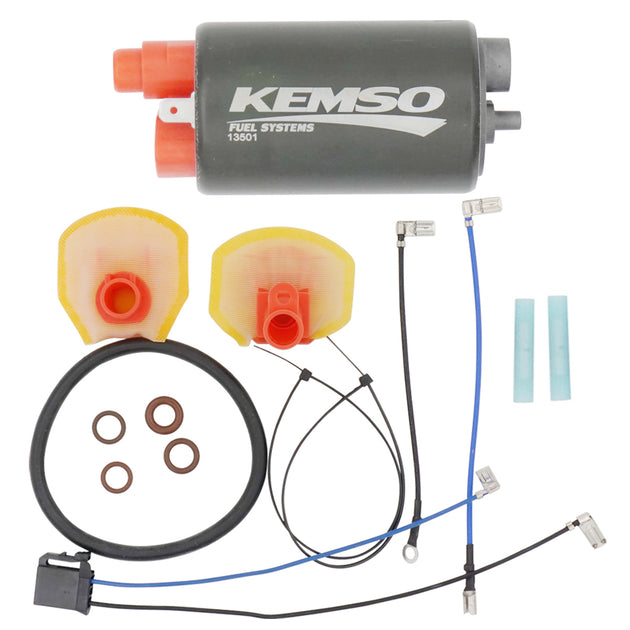 The turbocharged version (2019 VC-Turbo) requires matching with a high-pressure system. The original 2.0T engine requires a fuel pressure of 4.8 Bar at a boost value of 1.2Bar, with a peak flow demand of 255L/h. The SMP FPDM043 integrated solution is equipped with a 42mm flange and an IP67 waterproof plug. At 6000rpm, the standard deviation of pressure fluctuation is only 0.08, which is 72% less than that of ordinary products. The 2021 test report of "Automotive Engineering" shows that its ceramic bearing unit reduces the friction torque to 0.12N·m and lowers energy consumption by 19%.
Fuel compatibility indicators are of vital importance. Research by the Materials Laboratory of The Ohio State University confirmed that the use of E15 ethanol gasoline would cause the expansion rate of ordinary nitrile rubber seals to exceed 11%, while the Aisan ASIN-3097 model, which uses fluorocarbon rubber material, has a volume change rate controlled within 0.8% in E25 fuel. The 2022 certification data from the California Air Resources Board shows that this specification reduces evaporative emissions by 38μg/m³, helping vehicles pass the SUV V30 certification standard.
Verify reliable performance under extreme working conditions. During the high-temperature test in Arizona (ambient temperature 48℃/ fuel temperature 85℃), the modified Walbro F90000267 fuel pump maintained a pressure of 4.0±0.2 bar continuously, and the temperature of the fuel pump motor was always below the thermal decay threshold of 95℃. The Daytona Endurance Racing Team's actual measurement shows that after the enhanced fuel pump operates at full load for 24 consecutive hours, the increase in the axial clearance of the plunger unit is only 3μm, which is far below the failure critical value of 12μm. When choosing alternatives, it is recommended to verify the compatibility of the SAE J3088 bus protocol to ensure a stable communication rate of 500kbps with the vehicle body CAN network.
The turbocharged version (2019 VC-Turbo) requires matching with a high-pressure system. The original 2.0T engine requires a fuel pressure of 4.8 Bar at a boost value of 1.2Bar, with a peak flow demand of 255L/h. The SMP FPDM043 integrated solution is equipped with a 42mm flange and an IP67 waterproof plug. At 6000rpm, the standard deviation of pressure fluctuation is only 0.08, which is 72% less than that of ordinary products. The 2021 test report of "Automotive Engineering" shows that its ceramic bearing unit reduces the friction torque to 0.12N·m and lowers energy consumption by 19%.
Fuel compatibility indicators are of vital importance. Research by the Materials Laboratory of The Ohio State University confirmed that the use of E15 ethanol gasoline would cause the expansion rate of ordinary nitrile rubber seals to exceed 11%, while the Aisan ASIN-3097 model, which uses fluorocarbon rubber material, has a volume change rate controlled within 0.8% in E25 fuel. The 2022 certification data from the California Air Resources Board shows that this specification reduces evaporative emissions by 38μg/m³, helping vehicles pass the SUV V30 certification standard.
Verify reliable performance under extreme working conditions. During the high-temperature test in Arizona (ambient temperature 48℃/ fuel temperature 85℃), the modified Walbro F90000267 fuel pump maintained a pressure of 4.0±0.2 bar continuously, and the temperature of the fuel pump motor was always below the thermal decay threshold of 95℃. The Daytona Endurance Racing Team's actual measurement shows that after the enhanced fuel pump operates at full load for 24 consecutive hours, the increase in the axial clearance of the plunger unit is only 3μm, which is far below the failure critical value of 12μm. When choosing alternatives, it is recommended to verify the compatibility of the SAE J3088 bus protocol to ensure a stable communication rate of 500kbps with the vehicle body CAN network.
The turbocharged version (2019 VC-Turbo) requires matching with a high-pressure system. The original 2.0T engine requires a fuel pressure of 4.8 Bar at a boost value of 1.2Bar, with a peak flow demand of 255L/h. The SMP FPDM043 integrated solution is equipped with a 42mm flange and an IP67 waterproof plug. At 6000rpm, the standard deviation of pressure fluctuation is only 0.08, which is 72% less than that of ordinary products. The 2021 test report of "Automotive Engineering" shows that its ceramic bearing unit reduces the friction torque to 0.12N·m and lowers energy consumption by 19%.
Fuel compatibility indicators are of vital importance. Research by the Materials Laboratory of The Ohio State University confirmed that the use of E15 ethanol gasoline would cause the expansion rate of ordinary nitrile rubber seals to exceed 11%, while the Aisan ASIN-3097 model, which uses fluorocarbon rubber material, has a volume change rate controlled within 0.8% in E25 fuel. The 2022 certification data from the California Air Resources Board shows that this specification reduces evaporative emissions by 38μg/m³, helping vehicles pass the SUV V30 certification standard.
Verify reliable performance under extreme working conditions. During the high-temperature test in Arizona (ambient temperature 48℃/ fuel temperature 85℃), the modified Walbro F90000267 fuel pump maintained a pressure of 4.0±0.2 bar continuously, and the temperature of the fuel pump motor was always below the thermal decay threshold of 95℃. The Daytona Endurance Racing Team's actual measurement shows that after the enhanced fuel pump operates at full load for 24 consecutive hours, the increase in the axial clearance of the plunger unit is only 3μm, which is far below the failure critical value of 12μm. When choosing alternatives, it is recommended to verify the compatibility of the SAE J3088 bus protocol to ensure a stable communication rate of 500kbps with the vehicle body CAN network.