
Default
What flow rate do I need for 250cc dirt bikes?
The fuel flow rate required for a 250cc off-road motorcycle is not a fixed value. Its core depends on the specific design type of the engine (two-stroke or four-stroke), the target power output, and the speed range. Under normal circumstances, a modern four-stroke 250cc engine, with standard configurations (such as factory-set carburetors or electronic fuel injection systems), in order to maintain reliable operation throughout the full speed range (such as 8000- 11,000 RPM), Its Fuel supply system (the Fuel Pump is the core component of electronic fuel injection models) needs to provide a gasoline flow rate of approximately 100-140 liters per hour (LPH). This can be understood as the engine needs to inject 2 to 3 liters of gasoline per minute under high-speed and high-load conditions (such as long straight tracks on a racetrack). A notable example is the Honda CRF250R, whose peak power output usually needs to be matched with the corresponding fuel flow range.
The target output horsepower of the engine is a key parameter that determines the optimal flow rate. If the engine is modified and the target power is increased from about 35-40 horsepower of the original factory to over 50 horsepower (commonly seen in racing modified cars), its demand for fuel flow will increase significantly. Engines with large-displacement single-cylinder or multi-throat direct injection designs can have a flow demand that surges to 150 LPH or even higher under full throttle opening (WOT) conditions. Industry research data indicates that a 30% increase in power (for example, from 40 horsepower to 52 horsepower) often requires a corresponding 25-40% increase in fuel flow to ensure that the air-fuel ratio (AFR) can be maintained within the ideal range of 12.8:1 to 13.2:1. The oil pump upgrade and modification of professional off-road racing tracks is a typical market response.
The specific flow rate value still needs to be precisely calculated based on the number and size of nozzles and the working pressure of the system. A four-stroke single-cylinder 250cc electronic fuel injection engine is typically equipped with 1-2 fuel injectors, and the flow rate of a single nozzle (tested at a pressure of 3 Bar) is approximately within the range of 150-250 cc/ minute. When the system pressure is set at 45-60 PSI (approximately 3.1-4.1 Bar), considering that the duty cycle of the jet pulse width cannot exceed 85-90% (to prevent the nozzle from not being able to close completely), in order to meet the maximum flow demand, the minimum flow rate required for the gasoline pump should be 1.3-1.5 times the total theoretical maximum flow rate of the nozzle. For example, if the engine is equipped with an injector with a flow rate of 220 cc/ minute, the theoretical minimum flow rate required for the Fuel Pump should be 220 * 60/1000 * 1.5 ≈ 19.8 LPH; However, in practice, considering pressure fluctuations, flow loss and performance redundancy, the nominal flow rate of the pump actually selected is usually within the range of 120-140 LPH, which has been verified by the technical specifications of mainstream models such as Yamaha YZ250F.
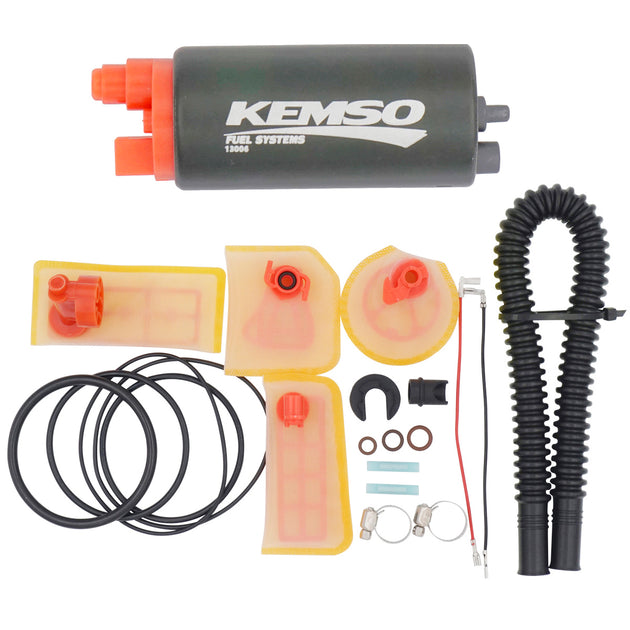 When conducting deep performance modifications (such as replacing pistons with high compression ratios, enlarging throttle bodies, and optimizing intake and exhaust systems) or during long periods of high-speed competition, the redundancy of the fuel supply system must be taken into consideration. It is recommended to choose a gasoline pump with a nominal flow rate 15-25% higher than the theoretical calculation value, such as a high-flow pump with a pH of 160-180 LPH. This can effectively deal with risks such as fuel supply pressure attenuation (the pressure drop after long-term operation may lead to a 5-10% flow loss), internal leakage in the fuel line (leakage from old fuel tanks or pipelines), and fuel temperature rise (the flow efficiency decreases when the fuel tank temperature exceeds 40°C). Meanwhile, increasing the volume of the oil rail to 100-150ml helps to buffer pressure fluctuations. Many professional off-road racing teams have found through data loggers that when driving at high speeds continuously, the oil pressure needs to be stabilized at 50 PSI to support the peak power, which requires a sufficient margin in the flow supply.
Excessive pursuit of extremely high flow rates (>200 LPH) may also bring about negative effects. Unnecessary increase in pump body load will lead to an increase in power consumption (possibly an increase of 1-2 amperes of current), and at the same time, the turbulent bubbles generated by excessive agitation of fuel in the tank will affect the pump oil efficiency. In extreme cases, the fluctuation range of the air-fuel ratio can reach ±0.5. The optimized solution is to select the gasoline pump with matching flow based on the actual horsepower test results (recording the actual fuel consumption rate data at different speed points such as 5000/8000/10000 RPM) and logs (recording the throttle opening, load, and air-fuel ratio parameters), ensuring that the pressure sensor reading fluctuates within ±5% under full throttle conditions. Experience shows that a well-matched gasoline pump can reduce the engine's thermal load by 20-30% and increase the overall lifespan of the fuel supply system.
When conducting deep performance modifications (such as replacing pistons with high compression ratios, enlarging throttle bodies, and optimizing intake and exhaust systems) or during long periods of high-speed competition, the redundancy of the fuel supply system must be taken into consideration. It is recommended to choose a gasoline pump with a nominal flow rate 15-25% higher than the theoretical calculation value, such as a high-flow pump with a pH of 160-180 LPH. This can effectively deal with risks such as fuel supply pressure attenuation (the pressure drop after long-term operation may lead to a 5-10% flow loss), internal leakage in the fuel line (leakage from old fuel tanks or pipelines), and fuel temperature rise (the flow efficiency decreases when the fuel tank temperature exceeds 40°C). Meanwhile, increasing the volume of the oil rail to 100-150ml helps to buffer pressure fluctuations. Many professional off-road racing teams have found through data loggers that when driving at high speeds continuously, the oil pressure needs to be stabilized at 50 PSI to support the peak power, which requires a sufficient margin in the flow supply.
Excessive pursuit of extremely high flow rates (>200 LPH) may also bring about negative effects. Unnecessary increase in pump body load will lead to an increase in power consumption (possibly an increase of 1-2 amperes of current), and at the same time, the turbulent bubbles generated by excessive agitation of fuel in the tank will affect the pump oil efficiency. In extreme cases, the fluctuation range of the air-fuel ratio can reach ±0.5. The optimized solution is to select the gasoline pump with matching flow based on the actual horsepower test results (recording the actual fuel consumption rate data at different speed points such as 5000/8000/10000 RPM) and logs (recording the throttle opening, load, and air-fuel ratio parameters), ensuring that the pressure sensor reading fluctuates within ±5% under full throttle conditions. Experience shows that a well-matched gasoline pump can reduce the engine's thermal load by 20-30% and increase the overall lifespan of the fuel supply system.
When conducting deep performance modifications (such as replacing pistons with high compression ratios, enlarging throttle bodies, and optimizing intake and exhaust systems) or during long periods of high-speed competition, the redundancy of the fuel supply system must be taken into consideration. It is recommended to choose a gasoline pump with a nominal flow rate 15-25% higher than the theoretical calculation value, such as a high-flow pump with a pH of 160-180 LPH. This can effectively deal with risks such as fuel supply pressure attenuation (the pressure drop after long-term operation may lead to a 5-10% flow loss), internal leakage in the fuel line (leakage from old fuel tanks or pipelines), and fuel temperature rise (the flow efficiency decreases when the fuel tank temperature exceeds 40°C). Meanwhile, increasing the volume of the oil rail to 100-150ml helps to buffer pressure fluctuations. Many professional off-road racing teams have found through data loggers that when driving at high speeds continuously, the oil pressure needs to be stabilized at 50 PSI to support the peak power, which requires a sufficient margin in the flow supply.
Excessive pursuit of extremely high flow rates (>200 LPH) may also bring about negative effects. Unnecessary increase in pump body load will lead to an increase in power consumption (possibly an increase of 1-2 amperes of current), and at the same time, the turbulent bubbles generated by excessive agitation of fuel in the tank will affect the pump oil efficiency. In extreme cases, the fluctuation range of the air-fuel ratio can reach ±0.5. The optimized solution is to select the gasoline pump with matching flow based on the actual horsepower test results (recording the actual fuel consumption rate data at different speed points such as 5000/8000/10000 RPM) and logs (recording the throttle opening, load, and air-fuel ratio parameters), ensuring that the pressure sensor reading fluctuates within ±5% under full throttle conditions. Experience shows that a well-matched gasoline pump can reduce the engine's thermal load by 20-30% and increase the overall lifespan of the fuel supply system.