
When a Miner Runs Under Spec: Counting the Terahashes That Vanished
A machine that has lost a tenth of its hashrate still looks busy: fans spin, lights blink, the pool keeps crediting. The loss is quiet and it compounds. At 312 TH/s a 10% shortfall costs about $34 a month at $84,692 per BTC, which is more than a replacement hash board and far more than a clean air filter.
Key takeaways
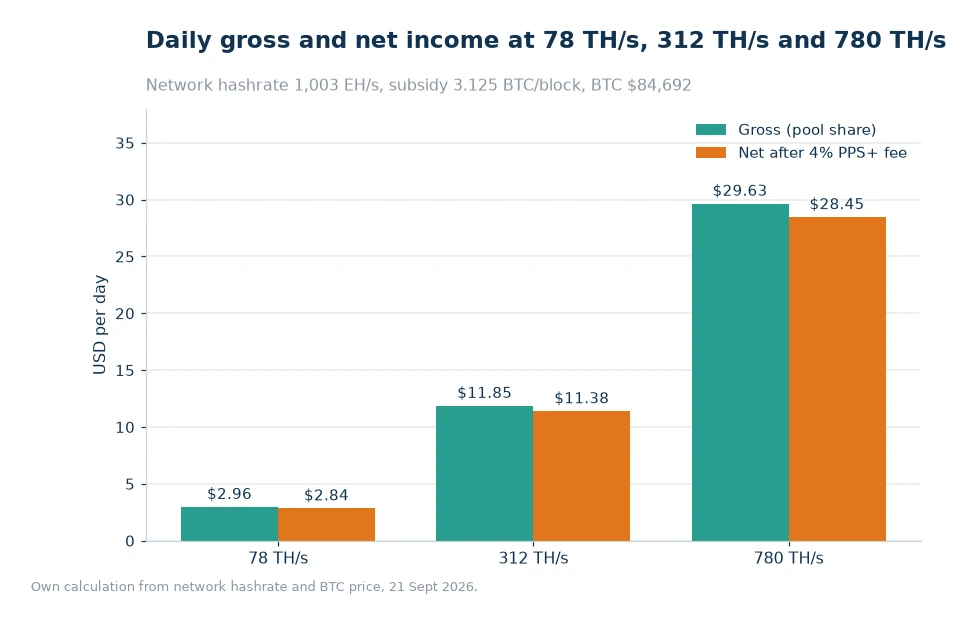
- 78 TH/s should return 0.00003500 BTC a day, $2.96 gross and $2.84 net at the listed 4%.
- 312 TH/s should return $11.85 gross and $11.38 net; 780 TH/s should return $29.63 and $28.45.
- A 10% shortfall costs roughly $8.52 a month on the smallest tier and $85.36 on the largest.
- Measure effective hashrate over 24 hours before ordering any part.
Three numbers that should agree
Every miner produces three versions of its own hashrate. The first is the label: what the model is rated to do. The second is the local reading: what the control board reports for the boards it can see. The third is the effective figure: what the pool counted as shares over a window. A healthy machine keeps all three within a couple of percent of each other.
Trouble usually appears as a gap between the second and third. The control board is optimistic because it counts work submitted, while the pool counts work accepted. Stale shares, rejected shares and a flaky network path all widen that gap without ever lighting a fault LED. That is why the pool's number, not the machine's, is the one to trust when the credit falls short.
What ten percent is worth
Ten percent sounds like a rounding error until it is multiplied by a month. The table holds the network constant and shows what the shortfall removes at each size, using the same per-terahash rate throughout.
| Rated hashrate | Net USD per day | Net if 10% short | Lost per 30 days | Missing hashrate |
|---|---|---|---|---|
| 78 TH/s | $2.84 | $2.56 | $8.52 | 7.8 TH/s |
| 312 TH/s | $11.38 | $10.24 | $34.14 | 31.2 TH/s |
| 780 TH/s | $28.45 | $25.61 | $85.36 | 78 TH/s |
The right-hand column is the useful one for diagnosis. Losing 78 TH/s from a 780 TH/s machine is the same as one whole small miner going dark, and it is usually one board, one cable or one fan shroud. Losing 7.8 TH/s from a 78 TH/s machine is a single chip chain, and it may not be worth repairing at all.
Check the cheap causes first
Before any diagnosis, confirm the machine is set to the plan you think it is. A worker pointing at PPLNS while the operator expects hourly PPS+ credits will look like a shortfall on the first day and then settle. Confirm the fee line too: a 4% listed rate applied to the block-reward portion is not a 4% cut of everything, and a misread statement can send an operator chasing a hardware fault that does not exist.
Then the physical basics. An inlet filter matted with dust will cut airflow enough to push a machine into thermal throttling on warm afternoons, which shows up as a hashrate line that dips and recovers with the ambient temperature. A loose PSU connector can cause a board to drop and rejoin, producing short spikes rather than a flat loss. Neither fault needs a new part; both need ten minutes and a torch.
Temperature is the usual culprit
Look at the hashrate curve against the clock, not just at the daily average. A machine that runs at full speed overnight and loses 8% between noon and five in the afternoon is telling you about its cooling, not its silicon. The same pattern appears when a rack gains a new neighbour and the exhaust of one unit feeds the inlet of another.
Firmware settings deserve a look as well. Some profiles trade hashrate for efficiency, and a machine restored from a backup can come back on a lower power target without any obvious warning. If the reported power draw is below the model's rated figure, the hashrate is probably below it too, and the fix is a setting rather than a repair.
Board-level faults look different
A failed chip chain produces a clean step, not a slope. The machine drops by a fixed fraction, holds there, and the control board may report one board as absent or as running at a fraction of its expected count. That is the case where the missing terahashes in the table become a repair decision: a board costs money and time, and the remaining life of the machine decides whether either is worth spending.
The Miner Profitability Ranking is a quick way to frame that decision, since it shows what current models return at today's difficulty. If a repaired unit still lands well below the current fleet average, the repair budget may be better spent elsewhere. Model-specific setup notes in the ViaBTC Mining Guide are worth checking before a board is condemned, because a wrong frequency setting can mimic a hardware fault.
Record a baseline before you need one
The hardest part of proving a shortfall is remembering what normal looked like. Record the effective hashrate and the daily credit for each machine on a quiet day, ideally just after a restart when the machine is at its best. Store the two figures next to the serial number. From then on, any comparison has a reference point.
The ViaBTC App makes the recording easy because effective hashrate and credit history sit in the same place. A screenshot once a week is enough. What matters is the series, not the precision of any single reading.
Worked example
Suppose a 312 TH/s machine credits $10.24 a day when the table says $11.38. Work out what that gap means before touching anything.
Expected daily coins: 312 ÷ 1,003,000,000 = 0.0000003111 of the network, times 450 BTC = 0.00013998 BTC. At $84,692 that is $11.85 gross, and after the 4% PPS+ charge, $11.38 net. The observed credit of $10.24 is 90% of that, so the machine is delivering about 281 TH/s effective rather than 312.
The missing 31 TH/s is worth $1.14 a day, which is $34.20 over 30 days. Power is the second half of the story: the machine still draws 8.736 kW, or 209.7 kWh a day at 28 J/TH, and that bill does not shrink when the pool credits 31 TH/s less. At $0.06 per kWh the power costs $12.58 a day against a $10.24 credit, so a 10% shortfall can be the difference between a thin margin and none at all. The repair budget should be measured against the monthly loss, not against the price of a new machine.
For the larger unit, the same 10% is 78 TH/s and $85.36 a month, which is why big machines justify a spare board on the shelf and small ones often do not.
Frequently asked questions
How do I know my miner is underperforming?
Compare effective hashrate, as counted by the pool, with the rated figure over at least 24 hours. A gap wider than about 5% that persists across a full day is a shortfall worth investigating.
Does a hot machine earn less?
Yes, once it throttles. Thermal protection reduces clock speed to protect the chips, so a machine running in poor airflow can lose several percent of its hashrate during the warmest hours.
Is a 10% loss worth repairing?
At 780 TH/s it is about $85 a month, which usually justifies a part. At 78 TH/s it is under $9 a month, and the cost of labour and shipping may exceed the recovered output.
Prove the shortfall before you buy a part
Give the machine a clean filter, a restart and 24 hours. Then compare the pool's effective figure with the number on the label. If the gap closes, the problem was airflow. If it does not, isolate by board and decide with the monthly loss in front of you. A look at the network statistics will confirm the rest of the network is behaving normally, so the only variable left is the machine on your bench.
Write the answer down, with the date and the serial number. A repair history is worth more than a hunch when the machine is eventually sold.
Sources: ViaBTC fee, ranking and statistics pages[1]. On 21 Sept 2026 the network read 1,003 EH/s at 132.76 T difficulty, with a 3.125 BTC subsidy every ten minutes and BTC at $84,692. Published 24 Oct 2026. Wattage and tariff figures in the example are assumptions.