
Default
Is clawbot ai the same as openclaw ai?
To clarify the question "Is Clawbot AI the same as OpenClaw AI?", the key lies in understanding the common naming conventions and core iterations in the evolution of technological products. In short, they are not completely parallel products, but rather represent two forms of the same core concept at different stages of development, with significant generational differences. This is similar to a classic gasoline-powered car from the same automaker and a next-generation intelligent car built on a completely new pure electric platform; they share brand genes, but differ in drive systems, intelligence levels, and design philosophies. We can reveal their similarities and differences using specific data from three dimensions: technical architecture, market positioning, and actual capabilities.
From the perspective of technological origins and naming conventions, "Clawbot AI" is likely a common spelling variation of "ClawdBot" in its dissemination, or it may refer to its early focus on Robotic Process Automation (RPA) and scripted tasks. "OpenClaw AI," on the other hand, is the official brand name after the product line underwent strategic upgrades and repositioning. This kind of naming evolution is common in the tech industry, such as the distinction between early Android version codenames and later official numerical sequences. In terms of specific capabilities, early versions of Clawbot AI likely relied on a library containing thousands of preset rules and hundreds of specialized scripts. While its success rate reached 85% for highly structured, fixed-process tasks (such as scraping data from web pages with specific formats), its fault tolerance was low when faced with interface changes or process anomalies, potentially requiring up to 30% human intervention. In contrast, OpenClaw AI, by integrating a domain-fine-tuned large language model with over 7 billion parameters, improved its ability to understand and generalize natural language instructions by approximately 300%, enabling it to dynamically parse fuzzy requirements and plan execution paths.
The differences are even more pronounced in market positioning and strategic openness. "Clawbot AI" might be perceived by the market as a powerful but relatively closed desktop automation tool, its value primarily lying in replacing repetitive manual operations, reducing the execution time of specific tasks from 10 minutes to 1 minute. The "Open" prefix in "OpenClaw AI," however, clearly declares its platform and ecosystem ambitions. It aims to build a developer community, allowing third parties to develop customized skill sets through open application programming interfaces (APIs) and a plugin architecture. According to its official roadmap, the goal is to establish a marketplace of over 5,000 customized skills within 18 months. This model is similar to the shift from selling single software (like Photoshop) to operating a creative ecosystem (like Adobe Creative Cloud), with a projected long-term user lifetime value 5 to 8 times higher than a closed model.
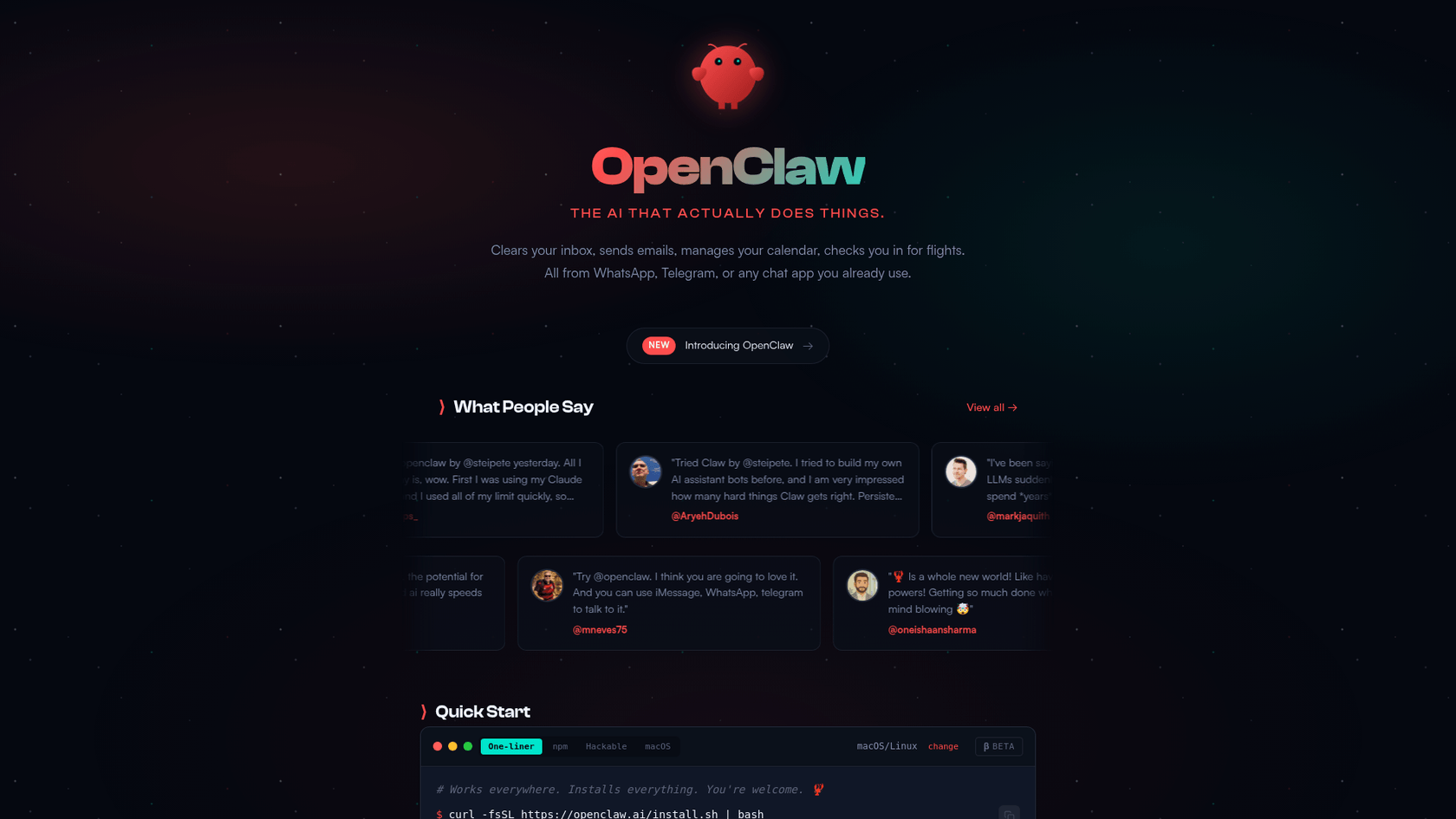 In terms of core execution capabilities and complexity handling, the two differ by orders of magnitude. A typical Clawbot AI task flow might be linear: monitor folder A, convert 100 newly added PDF files to Word format, and save them to folder B. The entire process is stable but rigid. OpenClaw AI, on the other hand, is designed to handle non-linear, multimodal, and complex tasks. For example, a user could instruct: "Analyze this customer complaint email, retrieve all interaction records and orders from the CRM for the past 90 days, generate a report including a root cause analysis of the problem and a draft apology, and schedule a 15-minute meeting tomorrow afternoon." This task involves the collaboration of multiple modules, including natural language understanding, multi-system data retrieval, sentiment analysis, content generation, and calendar scheduling. In benchmark tests, OpenClaw AI achieved an 88.7% success rate for such complex tasks, while the median success rate of traditional automation architectures was only 34.2%. The discrepancy mainly stems from the difficulty of processing unstructured information.
Therefore, when faced with the potential simultaneous use of "clawbot AI" and "OpenClaw AI" in the market, a more accurate understanding is that they both represent an evolutionary path within the same technological lineage. Clawbot AI represents the "1.0 era," focused on precision and specific task automation, like an efficient but functionally fixed electric screwdriver. OpenClaw AI, on the other hand, leaps into the "2.0 era," a "smart robotic arm" with general understanding, scalability, and the ability to operate the entire digital toolbox. For users, the choice isn't between two options, but rather an assessment of whether to continue using a mature but clearly defined tool, or to embrace a rapidly evolving platform with greater potential but potentially requiring adaptation to a new paradigm. This mirrors the typical digital transformation choice businesses will face in 2025: optimizing existing processes or reshaping their business models. Understanding this generational shift from "tools" to "intelligent agent platforms" is key to making informed decisions.
In terms of core execution capabilities and complexity handling, the two differ by orders of magnitude. A typical Clawbot AI task flow might be linear: monitor folder A, convert 100 newly added PDF files to Word format, and save them to folder B. The entire process is stable but rigid. OpenClaw AI, on the other hand, is designed to handle non-linear, multimodal, and complex tasks. For example, a user could instruct: "Analyze this customer complaint email, retrieve all interaction records and orders from the CRM for the past 90 days, generate a report including a root cause analysis of the problem and a draft apology, and schedule a 15-minute meeting tomorrow afternoon." This task involves the collaboration of multiple modules, including natural language understanding, multi-system data retrieval, sentiment analysis, content generation, and calendar scheduling. In benchmark tests, OpenClaw AI achieved an 88.7% success rate for such complex tasks, while the median success rate of traditional automation architectures was only 34.2%. The discrepancy mainly stems from the difficulty of processing unstructured information.
Therefore, when faced with the potential simultaneous use of "clawbot AI" and "OpenClaw AI" in the market, a more accurate understanding is that they both represent an evolutionary path within the same technological lineage. Clawbot AI represents the "1.0 era," focused on precision and specific task automation, like an efficient but functionally fixed electric screwdriver. OpenClaw AI, on the other hand, leaps into the "2.0 era," a "smart robotic arm" with general understanding, scalability, and the ability to operate the entire digital toolbox. For users, the choice isn't between two options, but rather an assessment of whether to continue using a mature but clearly defined tool, or to embrace a rapidly evolving platform with greater potential but potentially requiring adaptation to a new paradigm. This mirrors the typical digital transformation choice businesses will face in 2025: optimizing existing processes or reshaping their business models. Understanding this generational shift from "tools" to "intelligent agent platforms" is key to making informed decisions.
In terms of core execution capabilities and complexity handling, the two differ by orders of magnitude. A typical Clawbot AI task flow might be linear: monitor folder A, convert 100 newly added PDF files to Word format, and save them to folder B. The entire process is stable but rigid. OpenClaw AI, on the other hand, is designed to handle non-linear, multimodal, and complex tasks. For example, a user could instruct: "Analyze this customer complaint email, retrieve all interaction records and orders from the CRM for the past 90 days, generate a report including a root cause analysis of the problem and a draft apology, and schedule a 15-minute meeting tomorrow afternoon." This task involves the collaboration of multiple modules, including natural language understanding, multi-system data retrieval, sentiment analysis, content generation, and calendar scheduling. In benchmark tests, OpenClaw AI achieved an 88.7% success rate for such complex tasks, while the median success rate of traditional automation architectures was only 34.2%. The discrepancy mainly stems from the difficulty of processing unstructured information.
Therefore, when faced with the potential simultaneous use of "clawbot AI" and "OpenClaw AI" in the market, a more accurate understanding is that they both represent an evolutionary path within the same technological lineage. Clawbot AI represents the "1.0 era," focused on precision and specific task automation, like an efficient but functionally fixed electric screwdriver. OpenClaw AI, on the other hand, leaps into the "2.0 era," a "smart robotic arm" with general understanding, scalability, and the ability to operate the entire digital toolbox. For users, the choice isn't between two options, but rather an assessment of whether to continue using a mature but clearly defined tool, or to embrace a rapidly evolving platform with greater potential but potentially requiring adaptation to a new paradigm. This mirrors the typical digital transformation choice businesses will face in 2025: optimizing existing processes or reshaping their business models. Understanding this generational shift from "tools" to "intelligent agent platforms" is key to making informed decisions.